
Down the Years
The writing practice I'm using to engage with my creativity

For just over a month now, I’ve been writing first thing in the morning when I wake up. I made myself a book to use by gutting an old hardback cover (entitled DOWN THE YEARS) and filling it with signatures made from cartridge and sugar paper. I left a few of the original book pages in at the beginning and end.
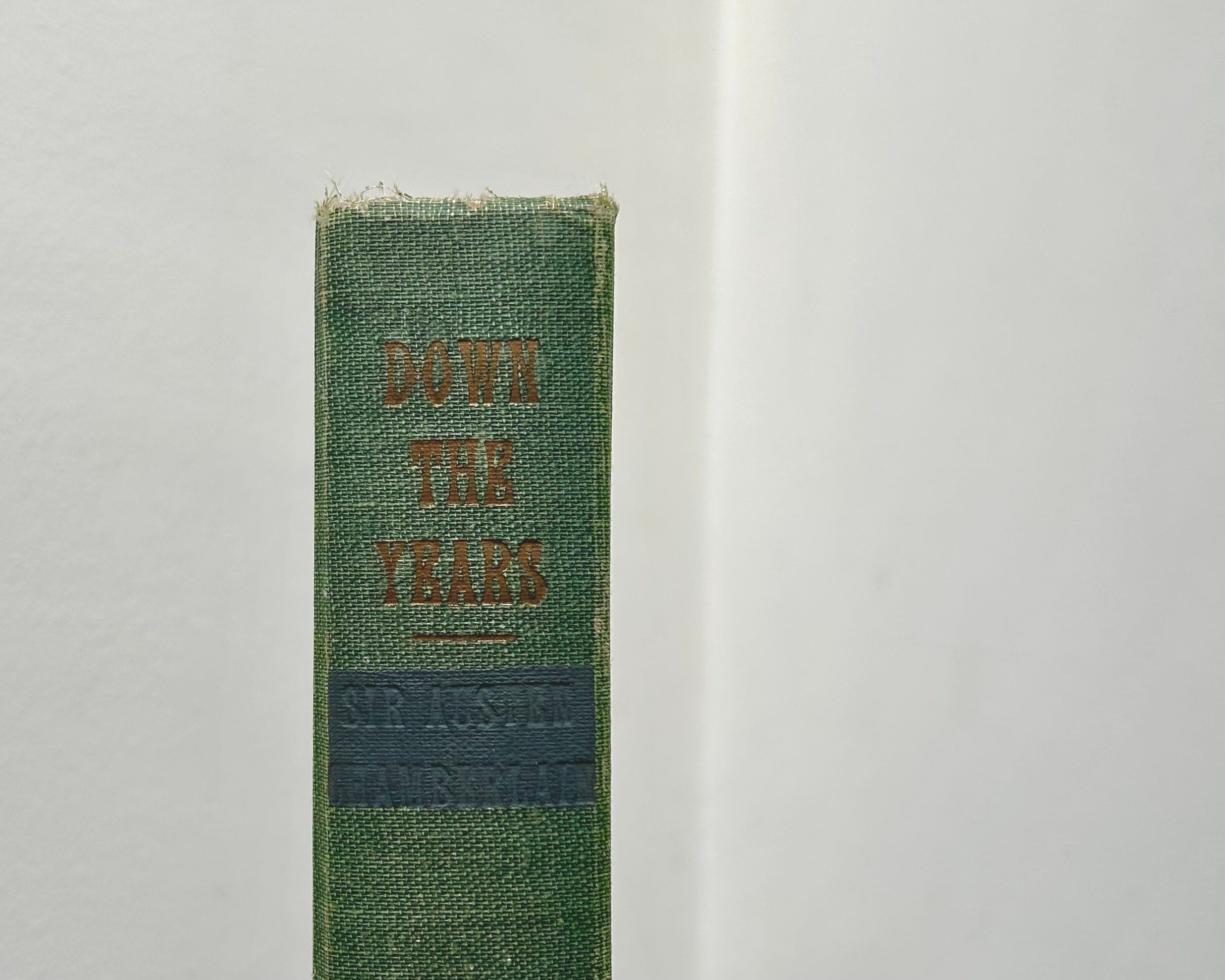
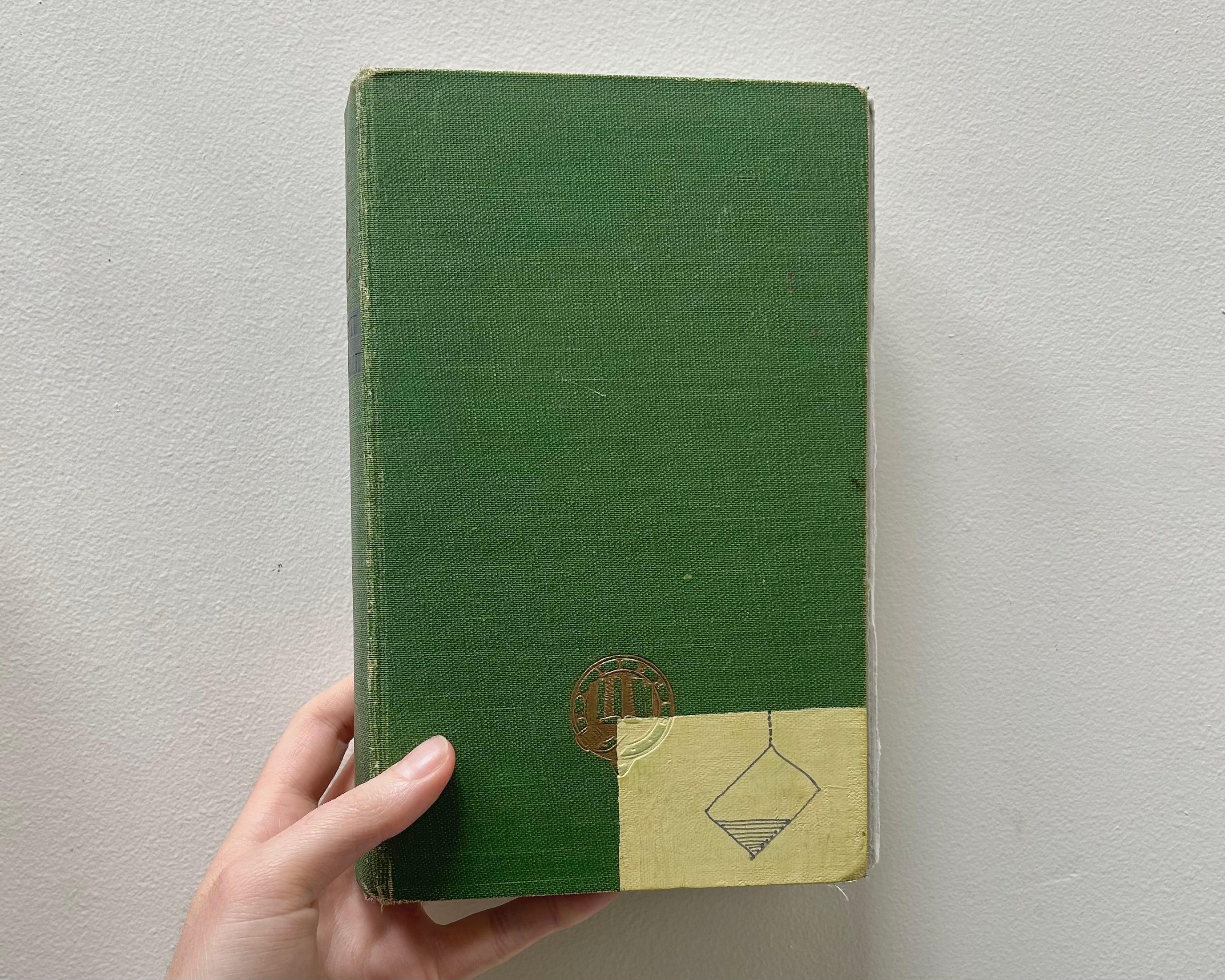
I’d like to share some of the ways that I’ve ended up using this book to write, and how they’re helping me to engage. The book has become a bit of an everything space, and there are three main ways that I’ve been using it.
The first is the most obvious – as a journal. I’ll see which parts of my previous day come to mind when I begin to write. I’m not trying to make an accurate account of each day, and I miss lots of things out. Lots of days I won’t write like this at all, but sometimes there are moments that feel important for me to record.
Secondly, I use the book to write notes on a short text or video that I’ve read/watched. I originally began writing in the green book as a commitment to follow Suleika Jaouad’s prompts in The Book of Alchemy (a book made up of 100 days of extracts from other writers and artists, followed by a journalling prompt by Suleika in response to the extract). I enjoyed the concept of reading a short passage before writing, in that it might provide a new lens through which to think when it came to beginning the page each day. I found some of the prompts really resonated with me, and some of them not so much. At this point, I decided I might better help myself by finding short videos on artists, writers, ideas, etc. to watch before I write, or short texts – a few pages from a book, or an article on Substack. I’ll link a few of my go to sources for videos at the end of the post.
Finally, the use of the book that I find most helpful, but that I don’t think I’d be able to do without the other two: I use the book to begin putting down thoughts on the page to do with creative writing. There are four main ‘prompts’ that I use to do this/to act as a starting point for when I’m not sure what to write.
Ten Images. This was one of the first prompts from The Book of Alchemy, and I shared an example of this in my last post. I find this often to be a more helpful way of reflecting on my past few days to tune into my creativity compared to writing about what’s happened. It forces me to think visually.
Ten Words. Similar concept, but instead I make a list of the words that are in my head at the moment of writing. Instead of conjuring visuals, like Ten Images, I often find myself writing down more conceptual words. I find it to be quite a slow process to think of these words because I want them to be intentional and precise choices. The list helps me pick out common themes in my thoughts and ideas that I might not have noticed before, by distilling everything into a format that is easy to view all at once.
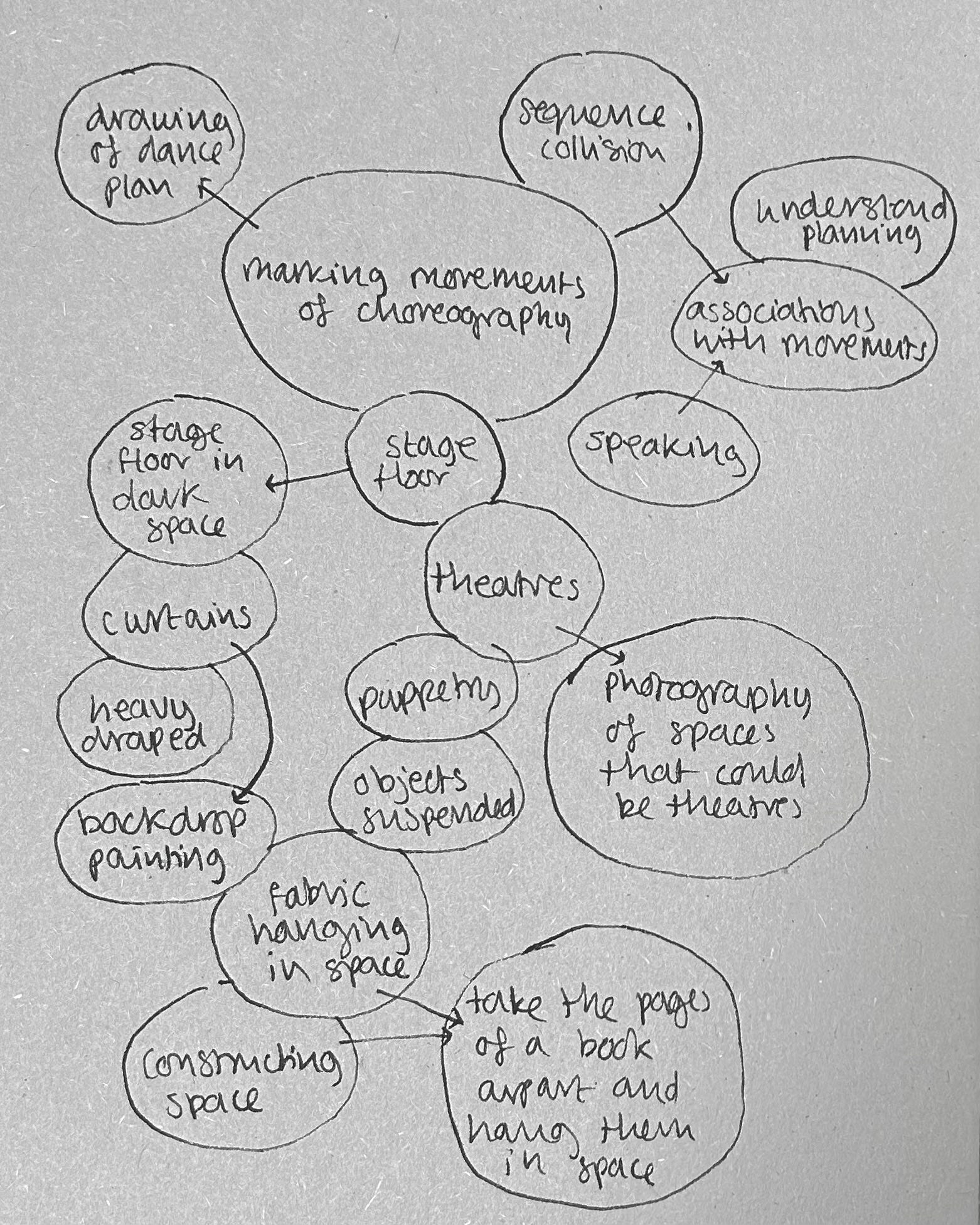
Adjacent Possible. This was an idea introduced to me by my mum, which she wrote about here. The Adjacent Possible is a term invented by Stuart Kauffman, which is guided by the fact that any new ideas and ways forwards, for each of us, are a result of where we currently are. My approach to figuring out my Adjacent Possibles is to write down something that I’m interested in in a circle in the middle of the page. Moving out from that, I’ll write, in circles like stepping stones, the ideas and images that this makes me think of. Almost like a mind map, this process helps me push at the edges of what I’m currently thinking, and notice the directions that I could take it, without having to commit to any in particular.
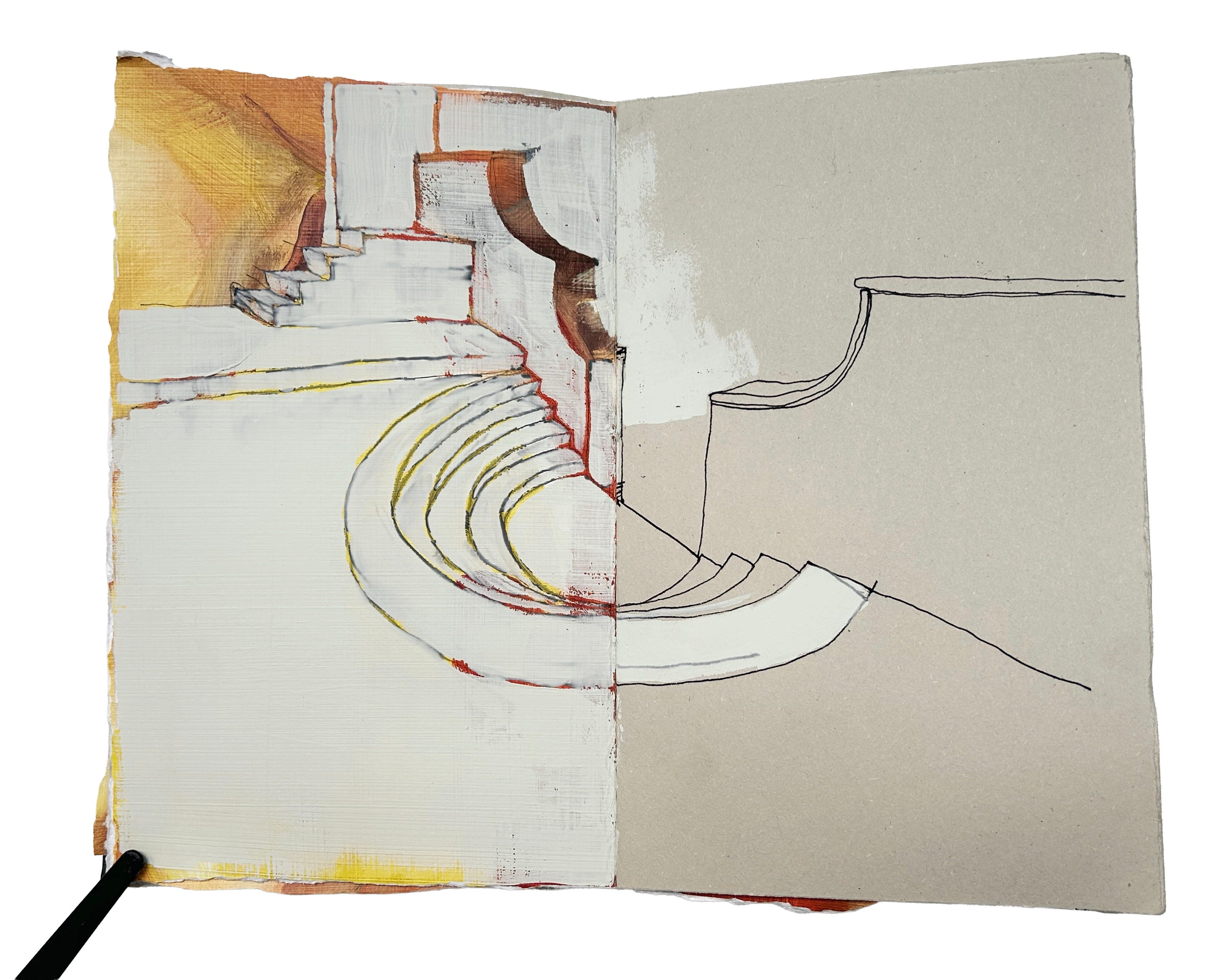
My Theatre. This was an idea I had for writing before I started the green book, and I began this digitally, in a word doc. I wanted somewhere to write creatively about spaces I’ve been to, spaces I imagine, and what I would make without the practical restraints of time, material, and ambition.
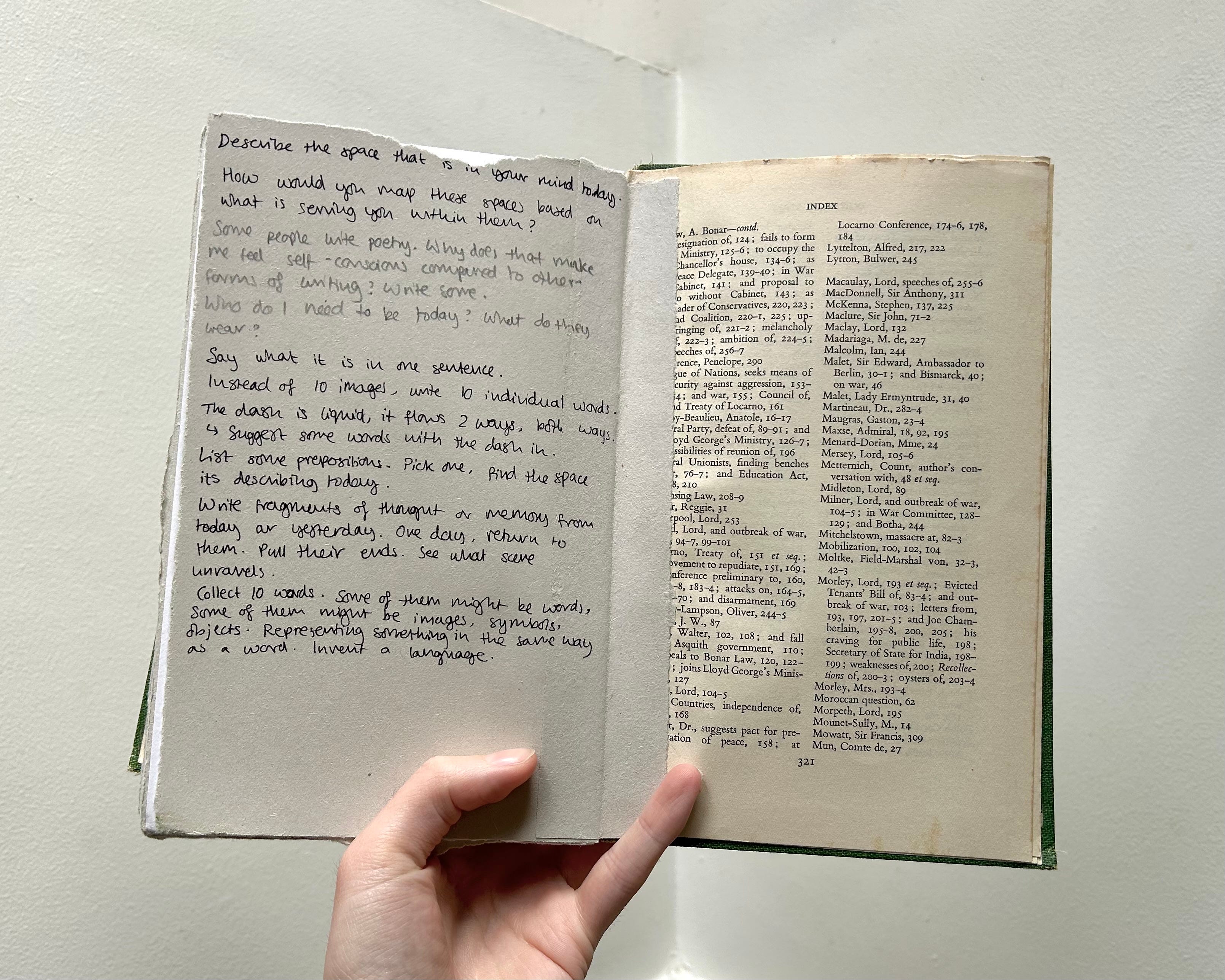
While I return to these four starting points most often, I also try to write myself a more specific prompt based on something that I pick up on from the text or video that I’ve read or watched. I’ll write these in a list at the back of the book, alongside the original index pages of DOWN THE YEARS. Some examples of recent prompts that I’ve written for myself, and what I’d read or watched prior:
List some prepositions. Pick one and find the space that it suggests.
Write fragments of thoughts or memories from today or yesterday. One day, return to them. Pull their ends. Observe the scene that unravels.
Who do I need to be today? What do they wear?
Say what it is in one sentence.
Making myself come up with these prompts helps me digest what I’ve read or watched, and on days when I have no idea what to write about they can be helpful in that they’re more specific.
Some days, I don’t do any creative writing in the green book, and I’ll just write a few sentences about my day instead. I think having these other forms of writing (journalling, note-taking) in the same place as my creative writing helps me keep the habit up. It helps me get to the point where I’m sat down with my book and I can figure out if I have something to write about or not, rather than just not getting to that space at all
Sources mentioned:
The Book of Alchemy: A Creative Practice for an Inspired Life - Suleika Jaouad
The "Adjacent Possible" – and How It Explains Human Innovation | Stuart Kauffman | TED
Cambridge Professor: Why All Writing Sounds the Same Now (Robert Macfarlane) - David Perell.
Writer Annie Ernaux: “I’m not trying to make it beautiful; I’m trying to make it right” - Louisiana Channel
Some sources I use to find short videos:
Opportunities of the Adjacent Possible

I think perhaps that the adjacent possible can help us feel safer in a space of not knowing, because we come to realise that in spaces of not knowing, we are not lost, and it is not chaos - instead, we stand in a space with which we are partly familiar, and we only have to be open enough to see the choices which are (at that time) available to us… We do…
Ten Images

Gabriel Orozco talks about using his camera as a ‘way of awareness’ while walking. He describes how not having a studio means he’s confronted with reality while in the creative process. During the summer break, spending time away from the studios in Oxford, I’ve been finding the ways that work for me to stay engaged and thinking about ideas. To stay obs…